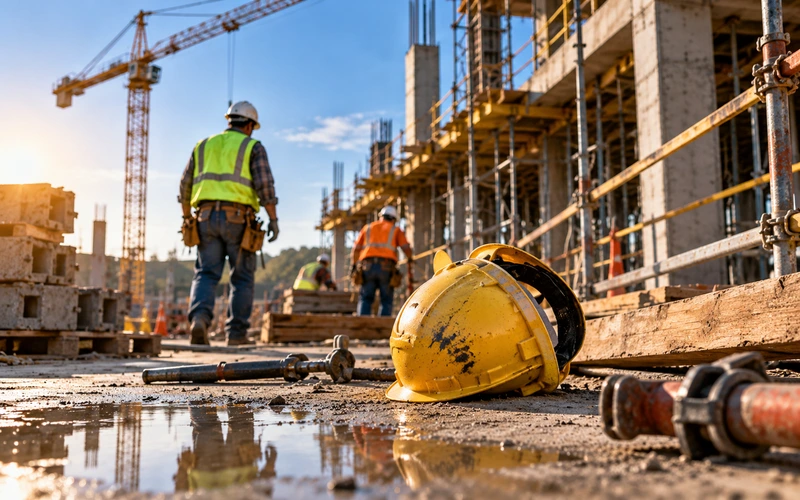
The most common construction site hazards are falls, struck-by incidents, caught-in or caught-between incidents, and electrocution. OSHA calls these the Focus Four because they cause a large share of construction worker deaths. Other frequent dangers include trench collapses, heat illness, toxic dust and chemicals, and vehicle and equipment accidents. When one of these hazards injures a worker, a construction accident lawyer can help determine who is responsible and what compensation may be available.
Construction remains one of the deadliest industries in the country. According to the Bureau of Labor Statistics, 1,034 private-sector construction workers died on the job in 2024, and more than a third of those deaths came from falls, slips, and trips. In Texas, the state's own fatality report for 2024 counted 128 construction deaths, roughly 23 percent of all workplace deaths in the state.
This guide walks through each major hazard, how it typically causes injuries, and what injured Texas workers should know about their legal options, including the unique rules for employers who do not carry workers' compensation.

OSHA built its construction safety training around the Focus Four hazards because they account for so many fatal and serious injuries. Each one is largely preventable with proper planning, equipment, and training.
Falls are the leading cause of construction deaths. They happen from roofs, ladders, scaffolds, steel beams, and openings in floors and decks. BLS reports that nearly all fatal construction falls in 2024 were falls to a lower level. OSHA's fall protection standard for construction, 29 CFR 1926.501, is the most frequently cited OSHA standard year after year, and scaffolding and ladder standards also regularly appear in the top ten. Missing guardrails, unsecured ladders, and workers without personal fall arrest systems are common causes.
Struck-by injuries occur when a worker is hit by a moving or falling object. Examples include tools dropped from height, loads swinging from cranes, flying debris from nail guns or saws, and vehicles or heavy equipment backing up on a busy site. Highway and road projects add the danger of passing traffic. These injuries are often severe, including head trauma and crushed limbs.
Caught-in and caught-between hazards involve a worker being squeezed, crushed, or pinched between objects. Trench collapses are among the most deadly examples, because collapsing soil can bury and crush a worker in seconds. Workers can also be pulled into unguarded machinery or pinned between equipment and a wall. Proper shoring, trench boxes, and machine guarding are the main defenses.
Electrocution hazards include contact with overhead power lines, damaged extension cords, improperly grounded tools, and exposed wiring in buildings under construction. Cranes, boom lifts, and ladders that touch power lines are a frequent source of fatal accidents. Lockout/tagout procedures and safe clearance distances help prevent these deaths.
Beyond the Focus Four, construction workers face a range of health and safety risks that can cause both sudden injuries and long-term illness:
• Heat illness: Texas summers expose outdoor crews to heat exhaustion and heat stroke, especially without water, shade, and rest breaks.
• Silica and other dust: cutting concrete, stone, and brick releases dust that can cause permanent lung disease.
• Hazardous chemicals: solvents, adhesives, and fumes can cause burns, respiratory injuries, and chemical exposure illnesses.
• Scaffold and structural collapses: overloaded or poorly built scaffolds can fail with workers on them, as in our report on the Port Arthur scaffolding collapse.
• Fires and explosions: hot work near flammable materials and gas lines can ignite without warning.
• Noise and vibration: long-term exposure can lead to hearing loss and nerve damage.
• Repetitive strain and overexertion: lifting heavy materials and awkward postures can cause back and joint injuries.
Construction sites usually involve many companies at once, so more than one party may share responsibility for an unsafe condition. Texas law treats claims against the employer and claims against other parties very differently.
Texas is the only state that does not require most private employers to carry workers' compensation insurance. If an employer does carry coverage, workers' comp benefits are generally the injured employee's exclusive remedy against that employer under Texas Labor Code 408.001. There is an important exception: when a worker is killed because of the employer's gross negligence or intentional conduct, the surviving spouse and children may seek exemplary damages. Contractors on public construction projects for Texas governmental entities must certify that they provide workers' comp coverage for their employees.
If an employer chose not to carry workers' compensation, it is known as a non-subscriber. An injured worker can sue a non-subscriber for negligence, and under Texas Labor Code 406.033, the employer loses key defenses. It cannot argue that the worker was negligent, assumed the risk, or was hurt because of a coworker's negligence. The worker still has to prove the employer was negligent. Our page on non-subscriber injuries explains this in more depth.
Even when workers' comp applies, an injured worker may have a claim against someone other than their employer. Possible third parties include general contractors, subcontractors, property owners, equipment manufacturers, and drivers of vehicles that enter the site. A defective scaffold, a crane with faulty controls, or a negligent subcontractor who left a trench unprotected can all support a third-party lawsuit. OSHA violations found during an investigation can also be strong evidence that safety rules were ignored. Texas generally allows two years to file a personal injury lawsuit under Tex. Civ. Prac. & Rem. Code 16.003, and evidence on a construction site can disappear quickly as work continues.
1. Get medical care right away and follow your doctor's instructions.
2. Report the injury to your supervisor in writing as soon as possible.
3. Write down the names of witnesses and the companies working in the area.
4. Take photos of the hazard, your injuries, and any equipment involved, if you safely can.
5. Keep copies of medical records, pay stubs, and any incident reports.
6. Speak with an attorney before giving recorded statements to an insurance company.
The Daspit Law Firm represents construction workers and their families across Texas, from Houston and Beaumont to Dallas, Fort Worth, Austin, and San Antonio. Our team of more than 50 attorneys has recovered over $500 million for clients. We work on a contingency fee basis, so there are no legal fees unless we win, and we offer free consultations 24/7 with home and hospital visits available.
Our Houston office is close to many of the region's largest construction and industrial projects. Founder John Daspit began his career at Fulbright & Jaworski and also worked in insurance defense, so we understand how employers and insurers defend these claims. We investigate the site, identify every responsible party, and fight for full compensation for medical bills, lost wages, and pain and suffering.
If you or a loved one was hurt by a hazard on a Texas construction site, call The Daspit Law Firm toll free at (888) 273-1045 for a free, confidential consultation. We are available 24 hours a day, 7 days a week.
The most common construction site hazards are falls, struck-by incidents, caught-in or caught-between incidents, and electrocution, which OSHA calls the Focus Four. Other frequent hazards include trench collapses, heat illness, silica dust, hazardous chemicals, scaffold failures, fires, and vehicle or heavy equipment accidents. Most of these injuries are preventable with proper planning, equipment, and training.
Falls are the leading cause of death in construction. BLS data shows 389 of the 1,034 private-sector construction worker deaths in 2024 came from falls, slips, and trips, more than a third of the total. Nearly all of those fatal incidents were falls to a lower level, such as from roofs, ladders, and scaffolds.
OSHA's Focus Four hazards are falls, caught-in or caught-between incidents, struck-by incidents, and electrocution. OSHA built its construction safety outreach training around these four because they cause a large share of construction fatalities. Each hazard has specific prevention measures, such as fall protection, trench protection, safe equipment operation, and keeping clear of power lines.
It depends on whether your employer carries workers' compensation. If it does, workers' comp is usually your only remedy against the employer, except for exemplary damages in certain death cases. If your employer is a non-subscriber, you can sue for negligence, and the employer cannot blame you for being careless. You may also have claims against third parties.
In most cases, you have two years from the date of the injury to file a personal injury lawsuit in Texas under Civil Practice and Remedies Code Section 16.003. Workers' compensation claims have their own shorter reporting and filing deadlines. Because jobsite evidence changes quickly, speaking with an attorney soon after the injury helps protect your claim.
All too often, accident victims are steamrolled by insurance companies determined to minimize or deny their claims. Don't let this happen to you. Hire us to fight for the compensation you deserve.


At The Daspit Law Firm, Our Team of Attorneys Handles the Full Range of Personal Injury Cases, Including Car and Truck Accidents, Industrial Accidents, Construction Accidents, Maritime & Offshore Accidents, and Much More.
The information on this website is for general information purposes only. Nothing on this site should be taken as legal advice for any individual case or situation. This information is not intended to create, and receipt or viewing does not constitute, an attorney-client relationship.
© 2026 All Rights Reserved. Privacy Policy, Accessibility, Legal Disclaimer