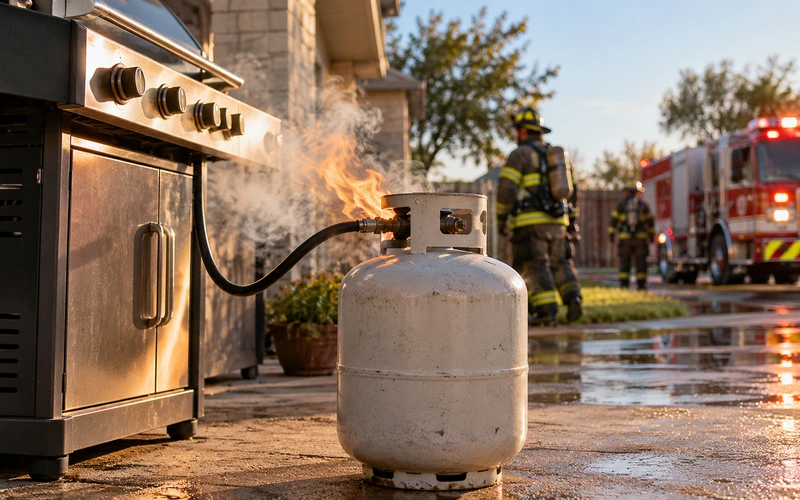
Yes, propane tanks can explode, but it is rare and almost always requires something to go wrong first, such as a fire heating the tank, physical damage, a faulty valve, or leaking gas that finds an ignition source. Propane cylinders and tanks are built with pressure relief valves and thick steel walls, so a tank in good condition, used correctly, should not simply blow up. When an explosion does happen, the injuries are often severe, and the cause frequently traces back to a defective part or careless handling that may support a product liability claim.
Propane is used across Texas for grills, rural homes, restaurants, food trucks, forklifts, and job sites. Because it is so common, it is easy to forget that it is a highly flammable fuel stored under pressure.
This guide explains the two main ways propane explosions happen, the most common causes, the safety rules that apply in Texas, and what injured people can do when someone else's mistake led to a blast.
There are two very different events people call a propane tank explosion. Knowing which one happened often matters a great deal when investigators and lawyers look for the cause.
The more common scenario is not the tank itself bursting. Instead, propane leaks from a loose connection, cracked hose, damaged regulator, or faulty valve. Propane is heavier than air, so escaping gas can collect in low spots such as basements, crawl spaces, and enclosed rooms. When that gas meets a pilot light, spark, cigarette, or electrical switch, it can ignite with explosive force. Propane is odorized so people can smell a leak, but the odor can fade or go unnoticed.
The tank can rupture in what experts call a BLEVE, short for boiling liquid expanding vapor explosion. According to Transport Canada's guidance, a BLEVE usually begins when fire heats a tank. The liquid propane boils, internal pressure climbs, and the relief valve opens to vent gas. As the liquid level drops, flames heat the upper steel wall that is no longer cooled by liquid. That steel weakens quickly, and when it can no longer hold the pressure, the tank tears open. The released propane can form a large fireball, and pieces of the tank can be thrown long distances.
BLEVEs can also follow impact damage, corrosion, or extreme heat, not only open flame. That is why firefighters keep their distance from a propane tank caught in a fire.
Most propane explosions trace back to equipment problems, poor maintenance, or human error. Common causes include:
• Leaking valves, regulators, hoses, or fittings.
• Overfilled cylinders that leave no room for the liquid to expand in hot weather.
• Defective cylinders, valves, or appliances with manufacturing or design flaws.
• Improper installation of tanks, gas lines, or appliances by an unlicensed or careless contractor.
• Storing cylinders indoors, in hot vehicles, or near heat sources.
• Physical damage from vehicles, dropping, or rust and corrosion.
• Fires that spread to a tank or cylinder.
• Failing to repair a reported leak or odor.
Several layers of rules are meant to prevent propane accidents, from national fire codes to Texas regulations.
Overfilling is a known hazard, so the national propane code, NFPA 58, requires an overfill prevention device on portable cylinders holding 4 to 40 pounds of propane, which includes the standard 20-pound grill tank. As the PHMSA overfill prevention device FAQ explains, the device is a backup shutoff built into the filling valve. Cylinders in this size range generally must have one to be refilled on or after April 1, 2002, with limited exceptions such as certain forklift and welding cylinders.
In Texas, propane is regulated by the Railroad Commission of Texas, not a fire marshal alone. Under Chapter 113 of the Texas Natural Resources Code, the Commission's Alternative Fuels Safety program enforces the LP-Gas Safety Rules in Title 16, Chapter 9 of the Texas Administrative Code. Those rules adopt NFPA 58 and NFPA 54 by reference and require companies that sell, install, or service propane equipment to be licensed. Licensees must report serious LP-gas incidents, including those causing death or hospitalization, to the Commission no later than two hours after finding out about the incident, followed by a written report.
More than one party can share responsibility for a propane explosion. Identifying all of them early helps protect your right to full compensation.
Texas law allows injured people to bring claims against manufacturers and sellers of defective products. A propane case may involve a design defect, a manufacturing defect in a specific valve or cylinder, or inadequate warnings and instructions. Preserving the failed tank, valve, hose, or appliance is critical, because experts will need to examine it.
Property owners and businesses that use propane, such as restaurants, apartment complexes, and campgrounds, must keep their property reasonably safe for guests. If an owner knew or should have known about a leak or unsafe tank and failed to fix it, an injured visitor may have a premises liability claim.
Propane companies and contractors who install tanks, run gas lines, or fill cylinders must follow the Railroad Commission's rules and adopted codes. Violations of those rules can be strong evidence of negligence. Industrial blasts may also raise issues seen in our coverage of the Fort Worth hotel gas explosion.
Texas uses proportionate responsibility, so a defendant may argue the injured person contributed to the accident. A person found more than 50 percent responsible cannot recover, and smaller shares reduce damages. Most injury lawsuits must be filed within two years under Civil Practice and Remedies Code Section 16.003.
The first hours after an explosion are confusing and painful. If you are able, these steps can protect both your health and your ability to hold the right party accountable:
1. Get to safety and call 911. Do not return to the area until firefighters say it is safe.
2. Seek medical care right away, even for burns that seem minor.
3. Do not throw away the tank, valve, grill, or appliance. Keep any receipts or exchange tags.
4. Photograph the scene, your injuries, and damaged property when it is safe.
5. Get names of witnesses, the propane supplier, and any installer or service company.
6. Speak with an attorney before giving recorded statements to insurers.
Explosion cases require fast investigation and experienced litigation. Our founder, John Daspit, devoted 7,000 to 8,000 hours to litigation over the 2005 BP Texas City Refinery explosion, and our firm handles catastrophic injuries such as severe burns. With more than 50 attorneys, over 15 offices, and over $500 million recovered for clients, we have the resources to take on manufacturers and large companies. We offer free consultations 24/7, home and hospital visits, and contingency fees, so you pay no legal fees unless we win.
If you or a loved one was hurt in a propane explosion or fire, call The Daspit Law Firm toll free at (888) 273-1045. We will fight to find out what went wrong and who should be held accountable.
It is very unlikely. A propane tank in good condition with a working relief valve should not explode without an outside cause. Explosions usually involve fire heating the tank, physical damage, corrosion, a defective valve, overfilling, or leaking gas that reaches an ignition source. Keeping tanks outdoors, upright, and away from heat greatly reduces the risk.
A BLEVE, or boiling liquid expanding vapor explosion, happens when a pressurized tank of liquefied gas such as propane suddenly ruptures. It usually starts when fire heats the tank, raising pressure and weakening the steel above the liquid line. When the wall fails, the propane releases at once, often creating a large fireball and throwing tank fragments.
An overfill prevention device, or OPD, is a backup shutoff built into the filling valve of a portable propane cylinder. It stops the tank from being filled past its safe limit. NFPA 58 requires OPDs on cylinders holding 4 to 40 pounds of propane, including standard grill tanks, for refills on or after April 1, 2002, with limited exceptions.
The Railroad Commission of Texas regulates propane, also called LP-gas, through its Alternative Fuels Safety program. It enforces the LP-Gas Safety Rules in Title 16, Chapter 9 of the Texas Administrative Code, which adopt national NFPA codes. Companies that sell, install, or service propane equipment must be licensed and must report serious incidents to the Commission.
Often, yes. Depending on the cause, you may have a product liability claim against a manufacturer or seller, a negligence claim against an installer or propane company, or a premises liability claim against a property owner. Texas generally allows two years to file. Preserve the tank and equipment, because they are key evidence in proving what failed.
All too often, accident victims are steamrolled by insurance companies determined to minimize or deny their claims. Don't let this happen to you. Hire us to fight for the compensation you deserve.


At The Daspit Law Firm, Our Team of Attorneys Handles the Full Range of Personal Injury Cases, Including Car and Truck Accidents, Industrial Accidents, Construction Accidents, Maritime & Offshore Accidents, and Much More.
The information on this website is for general information purposes only. Nothing on this site should be taken as legal advice for any individual case or situation. This information is not intended to create, and receipt or viewing does not constitute, an attorney-client relationship.
© 2026 All Rights Reserved. Privacy Policy, Accessibility, Legal Disclaimer