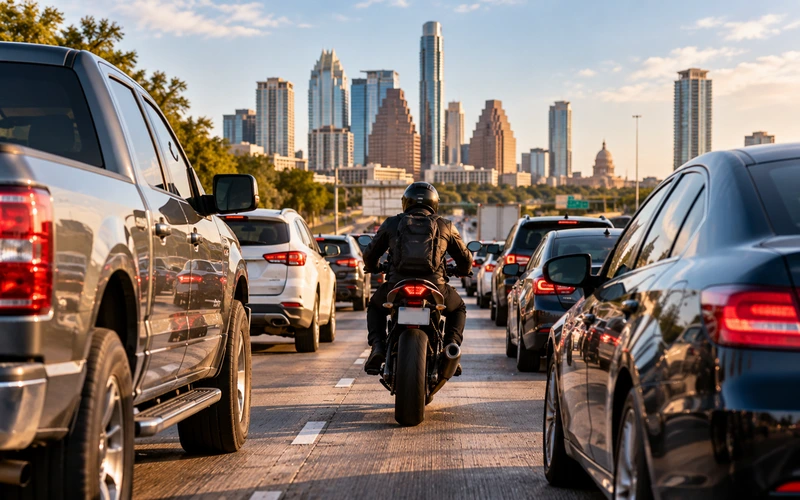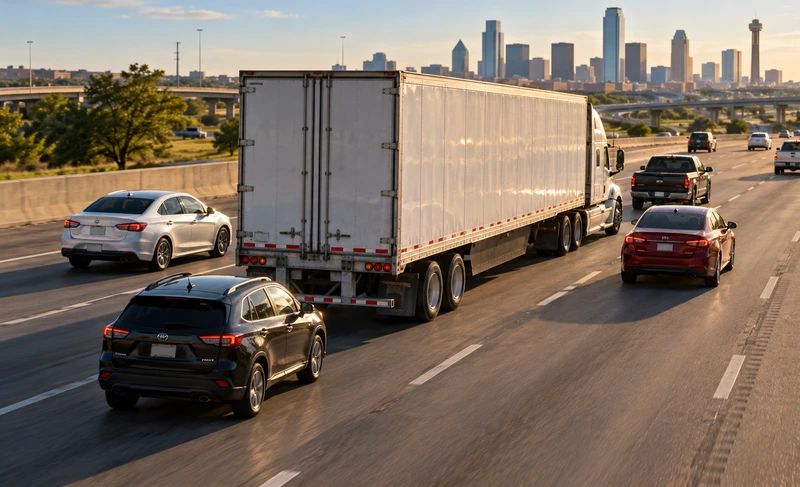
The No-Zone is the set of large blind spots around a tractor-trailer, bus, or other big commercial vehicle where the driver cannot see nearby cars. There are four No-Zones: directly in front of the cab, directly behind the trailer, along the left side, and a much larger area along the right side. Knowing where they are can help you avoid a crash, and if a truck accident does happen, it can help explain who was really at fault.
The term comes from federal safety outreach. The Federal Motor Carrier Safety Administration (FMCSA) uses "No-Zone" in its Our Roads, Our Safety campaign to warn drivers that trucks and buses have blind spots on all four sides. A simple rule of thumb from FMCSA: if you cannot see the truck driver in their side mirror, assume the driver cannot see you.
Below, we break down each No-Zone, explain why trucks need so much more room to stop and turn, and cover how Texas law treats blind spots when deciding who pays for a crash.

Blind spots are only part of the danger. Trucks are far heavier and harder to stop than passenger cars, which leaves less room for error when a car appears suddenly.
According to FMCSA's Our Roads, Our Safety brochure, a fully loaded truck traveling at highway speed in good conditions needs almost two football fields to stop, and trucks can weigh 20 to 30 times more than passenger vehicles. FMCSA's infographic adds that trucks take about 40 percent longer to stop than cars. Rain, heavy loads, and worn brakes stretch those distances further.
A tractor-trailer often needs to swing left before turning right, and its trailer tracks inside the path of the cab. FMCSA's materials show a turning radius of about 55 feet. Drivers who squeeze between a turning truck and the curb can end up trapped in the right-side No-Zone. Pedestrians and cyclists face the same risk at intersections.
Most No-Zone crashes can be prevented when both drivers take care. These habits, drawn from FMCSA guidance, can lower your risk.
• Look for the driver's face in the side mirror. If you cannot see it, you are in a blind spot.
• Pass on the left, signal clearly, and move past the truck without slowing down beside it.
• Leave extra room before moving back in front of a truck after passing.
• Avoid passing on downgrades, where trucks tend to pick up speed.
• Watch for wide turn signals and never pull up between a turning truck and the curb.
• Put your phone away. Underestimating a truck's speed during a merge is a common and serious mistake.
Being in a truck's No-Zone does not make a driver automatically at fault. Truck drivers are trained professionals, and the law expects them to account for their own blind spots.
Texas Transportation Code Section 545.060 allows a driver to leave a lane only when the move can be made safely. Federal rules at 49 CFR 393.80 require trucks to have mirrors on both sides so the driver can see the road behind along each side. A driver who changes lanes or turns without checking mirrors, signaling, and making sure the space is clear may be found negligent. Many carriers also equip trucks with blind spot cameras or sensors, and records from those systems can become key evidence.
A motor carrier may share responsibility if it failed to train drivers properly, pushed unrealistic delivery schedules, or ignored broken mirrors and equipment. These issues fall under general negligence principles and federal safety rules. Evidence such as dashcam footage, electronic logging device data, and maintenance records can show what really happened.
Texas uses a modified comparative fault rule under Chapter 33 of the Civil Practice and Remedies Code. If you are found partly at fault, for example for lingering in a blind spot, your damages are reduced by your share. You can still recover as long as you are not more than 50 percent responsible. Insurance companies often try to blame the car driver to shrink payouts, which is why an independent investigation matters.
Deadlines also apply. Most Texas personal injury claims must be filed within two years of the crash under Civil Practice and Remedies Code Section 16.003.
The Daspit Law Firm has more than 50 attorneys and has recovered over $500 million for clients. We handle truck crash cases on a contingency fee, so you pay no legal fees unless we win. Our lawyers move quickly to preserve electronic data, camera footage, and maintenance records before they disappear. Truck crashes often lead to catastrophic injuries, and we can meet with you at home or in the hospital while you recover.
Founder John Daspit began his career at Fulbright & Jaworski and also worked in insurance defense, so our team understands how carriers and their insurers build a defense. From our main office in Houston and offices across Texas, including Beaumont, Dallas, and San Antonio, we serve families along the state's busiest freight corridors.
If a truck driver changed lanes or turned into you, do not let the company tell you it was your fault for being in a blind spot. Call The Daspit Law Firm at (888) 273-1045 for a free consultation, available 24/7. We are ready to fight for you.
The No-Zone is the area around a large truck or bus where the driver cannot see other vehicles. It includes four blind spots: directly in front of the cab, directly behind the trailer, along the left side, and a wider area along the right side. FMCSA advises drivers that if they cannot see the truck driver in the mirror, the driver cannot see them.
FMCSA's safety infographic marks about 20 feet in front of the cab, about 30 feet behind the trailer, one lane on the left side, and two lanes on the right side. Actual blind spots vary based on the truck, trailer length, mirror setup, and driver position, so it is safest to give large trucks extra room on every side.
The right-side No-Zone is generally the largest and most dangerous. It can span two lanes and run back along much of the trailer, making it hard for the driver to see a car there. Trucks also make wide right turns, so cars that pull up on the right at intersections can be caught in that blind spot.
Not automatically. Texas law requires drivers to change lanes only when it is safe, and truckers must use mirrors and check their blind spots. Fault depends on the facts. Under Texas comparative fault rules, you can still recover damages if you are 50 percent or less responsible, though your award is reduced by your share of fault.
According to FMCSA, a fully loaded truck at highway speed in good conditions needs almost two football fields to stop. FMCSA also notes that trucks take about 40 percent longer to stop than cars. Wet roads, heavy loads, and brake problems increase that distance, which is why cutting in front of a truck is so dangerous.
All too often, accident victims are steamrolled by insurance companies determined to minimize or deny their claims. Don't let this happen to you. Hire us to fight for the compensation you deserve.


At The Daspit Law Firm, Our Team of Attorneys Handles the Full Range of Personal Injury Cases, Including Car and Truck Accidents, Industrial Accidents, Construction Accidents, Maritime & Offshore Accidents, and Much More.
The information on this website is for general information purposes only. Nothing on this site should be taken as legal advice for any individual case or situation. This information is not intended to create, and receipt or viewing does not constitute, an attorney-client relationship.
© 2026 All Rights Reserved. Privacy Policy, Accessibility, Legal Disclaimer