GVWR stands for gross vehicle weight rating. It is the maximum loaded weight a manufacturer says a single vehicle can safely carry, including the vehicle itself, fuel, passengers, and cargo. It is a safety limit set at the factory, not the truck's actual weight on a given day. After an 18-wheeler accident, the GVWR often becomes key evidence because it shows whether a truck was loaded beyond what its brakes, tires, axles, and frame were built to handle.
GVWR also decides which federal rules apply to a vehicle and its driver. Once a truck crosses certain weight thresholds, the motor carrier and driver must follow Federal Motor Carrier Safety Administration (FMCSA) regulations, and heavier trucks require a commercial driver's license.
Below, we explain what GVWR means, how it differs from related terms, how much common trucks weigh, and why weight matters so much when a Texas family is hurt in a crash with a commercial vehicle.

Federal regulations define GVWR as the value the manufacturer specifies as the maximum loaded weight of a single motor vehicle. You can find it on the certification label, usually on the driver's door or door jamb. The definition appears in 49 CFR 390.5, the FMCSA's general definitions section.
Manufacturers set GVWR based on the weakest load-bearing component, which may be the axles, suspension, tires, wheels, or brakes. Exceeding the rating does not mean a truck will fail immediately, but it reduces the safety margin engineers built into the vehicle.
Several weight terms sound alike but mean different things. Understanding each one helps when reviewing a crash report or a trucking company's records.
Gross vehicle weight is what a vehicle actually weighs at a specific moment, with its current load. A truck's GVW changes with every delivery. GVWR is the ceiling, and GVW is the real number on the scale. If GVW is higher than GVWR, the vehicle is overloaded under the manufacturer's rating.
GCWR is the maximum combined weight of a power unit and everything it tows, such as a tractor pulling a semitrailer. Under federal rules, it is the manufacturer's stated value or the combined ratings of the power unit and towed units, whichever is higher.
Curb weight is the weight of an empty vehicle with standard equipment and fluids, but no driver, passengers, or cargo. Payload is the amount of weight a vehicle can add before reaching its GVWR. Put simply, curb weight plus payload equals GVWR.
Under 49 CFR 390.5, a vehicle used in interstate commerce with a GVWR or GCWR of 10,001 pounds or more is generally a commercial motor vehicle, which brings FMCSA safety rules into play. Under 49 CFR 383.91, a single vehicle with a GVWR of 26,001 pounds or more falls into CDL Group B, and a combination of 26,001 pounds or more towing a unit rated above 10,000 pounds falls into Group A. Texas applies similar rules to intrastate carriers, with some differences.
Actual weights vary widely, but industry sources give useful ranges:
• Semi-truck (tractor only): roughly 10,000 to 25,000 pounds, depending on the cab and engine.
• Empty tractor-trailer: roughly 30,000 to 35,000 pounds combined.
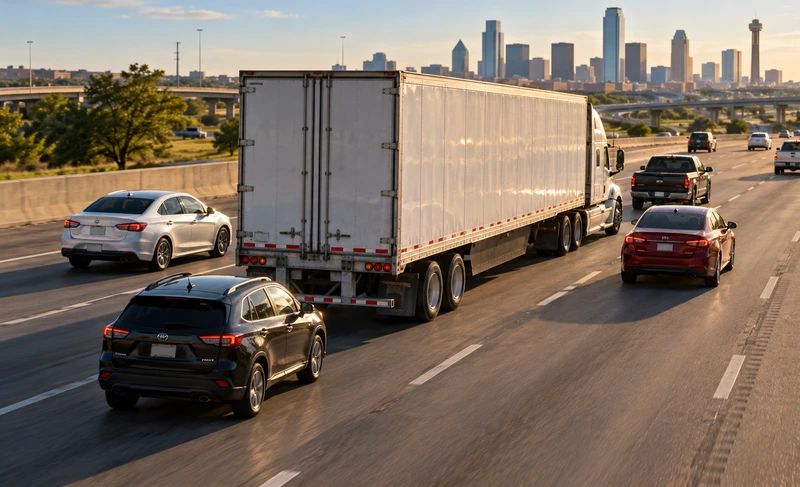
• Fully loaded tractor-trailer: up to 80,000 pounds on the Interstate without a special permit.
• Standard or tandem-axle dump truck: roughly 25,000 to 30,000 pounds empty, with GVWRs often in the 54,000 to 65,000 pound range.
• Tri-axle dump truck: GVWRs commonly in the 65,000 to 80,000 pound range when loaded.
The Insurance Institute for Highway Safety notes that large trucks often weigh 20 to 30 times more than passenger vehicles. That gap explains why occupants of the smaller vehicle usually suffer the worst injuries. Dump trucks working near highway projects and construction accidents sites add to that risk on Texas roads.
GVWR is a manufacturer's rating, but the government also sets legal limits on how heavy a truck can be on public roads. Both matter after a crash.
On the Interstate system, federal law caps gross vehicle weight at 80,000 pounds, with 20,000 pounds per single axle and 34,000 pounds per tandem axle group. The Federal Bridge Formula can set a lower limit depending on the number of axles and the spacing between them, because concentrating weight in a short space stresses bridges.
The Texas Department of Motor Vehicles lists the same basic legal limits for Texas roads: 80,000 pounds gross, 20,000 pounds on a single axle, 34,000 on a tandem, and 42,000 on a triple axle group. Loads that exceed these limits need an oversize or overweight permit from TxDMV, which sets higher axle limits and may require route approval. A permit allows the extra weight on approved routes, but it does not excuse a carrier from loading safely, securing cargo, or maintaining brakes.
Weight affects nearly every part of a crash. A heavier truck needs more distance to stop, carries more momentum into a collision, and is more prone to rollovers and jackknifes when cargo shifts. In a claim, investigators often compare the truck's GVWR to its actual weight at the time of the crash.
1. Identify the vehicle: the certification label shows the GVWR and axle ratings.
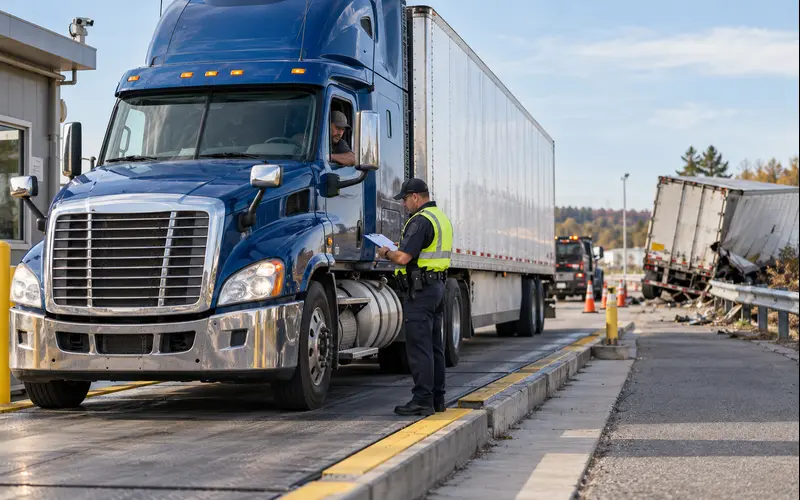
2. Find the actual weight: bills of lading, scale tickets, weigh station records, and dispatch logs can show what the truck was carrying.
3. Compare the numbers: a GVW above the GVWR or above legal limits may point to negligent loading or dispatching.
4. Check permits: if the truck needed an overweight permit, investigators confirm whether it had one and followed its route.
5. Review maintenance: overloaded trucks wear out brakes and tires faster, so inspection and repair records matter.
Evidence of overloading can support claims against more than the driver. The motor carrier, a shipper that loaded the trailer, or a maintenance contractor may share responsibility. When a crash causes catastrophic injuries or a death, these records can affect the value of the case. A prompt police report also helps tie the truck's identification to the crash. Texas generally allows two years to file a personal injury lawsuit under Tex. Civ. Prac. & Rem. Code 16.003, but evidence like electronic data and scale records should be requested much sooner.
The Daspit Law Firm represents people hurt in commercial vehicle crashes across Texas, with offices in Houston, Austin, Beaumont, Dallas, Fort Worth, Galveston, and San Antonio. Our team of more than 50 attorneys has recovered over $500 million for clients. We work on a contingency fee, so you pay no legal fees unless we win, and we offer free consultations 24/7 with home and hospital visits available.
Our founder began his career at Fulbright & Jaworski and also worked in insurance defense, so our legal team understands how trucking insurers evaluate claims. We move quickly to request weight records, electronic logging data, and maintenance files, and we fight to hold every responsible party accountable.
If a heavy truck injured you or someone you love, call The Daspit Law Firm toll free at (888) 273-1045. Your consultation is free and confidential, and we answer calls 24 hours a day.
GVWR, or gross vehicle weight rating, is the maximum loaded weight a manufacturer says a single vehicle can safely handle. It includes the vehicle itself plus fuel, passengers, and cargo. The rating appears on the certification label on the driver's door or door jamb, and federal regulations use it to decide which safety and licensing rules apply.
GVWR is a fixed maximum set by the manufacturer, while gross vehicle weight is what the vehicle actually weighs at a given moment with its current load. A truck's gross vehicle weight changes with each load. If the actual weight exceeds the GVWR, the vehicle is overloaded under the manufacturer's rating and may be less safe to operate.
A fully loaded tractor-trailer can legally weigh up to 80,000 pounds on the Interstate without a special permit. An empty tractor-trailer typically weighs about 30,000 to 35,000 pounds. Trucks carrying heavier loads in Texas need an oversize or overweight permit from the Texas Department of Motor Vehicles, and they must follow approved routes.
Under federal rules, a CDL is generally required for a single vehicle with a GVWR of 26,001 pounds or more, or a combination of 26,001 pounds or more when the towed unit is rated above 10,000 pounds. Smaller vehicles may also require a CDL if they carry 16 or more people or placarded hazardous materials.
It can. Overloading increases stopping distance and the risk of brake failure, rollovers, and jackknifes. If evidence shows a truck exceeded its GVWR or legal weight limits, the motor carrier, the shipper that loaded it, or others may share responsibility. Scale tickets, bills of lading, and permits help prove the truck's actual weight at the time of the crash.
All too often, accident victims are steamrolled by insurance companies determined to minimize or deny their claims. Don't let this happen to you. Hire us to fight for the compensation you deserve.


At The Daspit Law Firm, Our Team of Attorneys Handles the Full Range of Personal Injury Cases, Including Car and Truck Accidents, Industrial Accidents, Construction Accidents, Maritime & Offshore Accidents, and Much More.
The information on this website is for general information purposes only. Nothing on this site should be taken as legal advice for any individual case or situation. This information is not intended to create, and receipt or viewing does not constitute, an attorney-client relationship.
© 2026 All Rights Reserved. Privacy Policy, Accessibility, Legal Disclaimer