The underwater welding death rate is not 15%, despite how often that number circulates online. The best federal data suggest commercial divers, the occupation that includes underwater welders, die on the job at roughly 150 to 180 per 100,000 workers per year, which works out to about five deaths annually and a rate dozens of times higher than the average American job. If you or a family member was hurt in this work, our maritime injury lawyers can explain which federal laws apply to your claim.
That rate makes underwater welding one of the most dangerous trades in the country, even if it is far less deadly than the viral statistic suggests. Below, we walk through where the numbers come from, what actually kills and injures divers, and how the Jones Act, the Longshore and Harbor Workers' Compensation Act (LHWCA), and general maritime law protect workers along the Texas Gulf Coast.
Texas is one of the leading states for commercial diving jobs, with divers supporting offshore platforms, pipelines, ship repair yards, and port infrastructure from Port Arthur to Corpus Christi. When something goes wrong underwater, the consequences are usually severe, and the legal questions that follow are more technical than in a typical work injury case.
No federal agency tracks underwater welders as their own category. The Bureau of Labor Statistics groups them under commercial divers, so the most reliable figures describe divers as a whole. Two federal sources give the clearest picture.
A 1998 CDC report on occupational diving deaths cited OSHA records showing 116 occupational diving fatalities nationwide from 1989 to 1997. Of those, 49 deaths, about five per year, occurred among an estimated 3,000 full-time commercial divers. The CDC calculated a rate of 180 deaths per 100,000 divers per year, roughly 40 times the national death rate for all workers at the time.
Newer numbers point in the same direction. According to the NIOSH commercial diving page, the Bureau of Labor Statistics recorded 39 fatal occupational injuries among commercial divers from 2011 to 2017, plus 460 nonfatal injuries and illnesses serious enough to cause days away from work. NIOSH estimated there were about 3,380 commercial divers in the United States at that time.
Thirty-nine deaths over seven years is between five and six per year. Divided across roughly 3,000 to 3,400 divers, that implies an annual fatality rate in the range of about 150 to 180 per 100,000 workers. This is our own rough calculation, not an official BLS rate, but it lines up closely with the CDC figure. For comparison, BLS reported an overall fatal work injury rate of 3.3 per 100,000 full-time workers across all U.S. jobs in 2024.
Many career and welding websites claim underwater welding has a fatality rate near 15%, but none of them cite a study that supports it. A 15% annual death rate would mean roughly 450 of the country's 3,000 or so commercial divers dying every year. Federal data show about five or six. The number appears to be a myth repeated from site to site.
The honest answer is still sobering. A commercial diver faces a risk of dying on the job that is dozens of times higher than the average worker, which is exactly why the law gives these workers special protections.
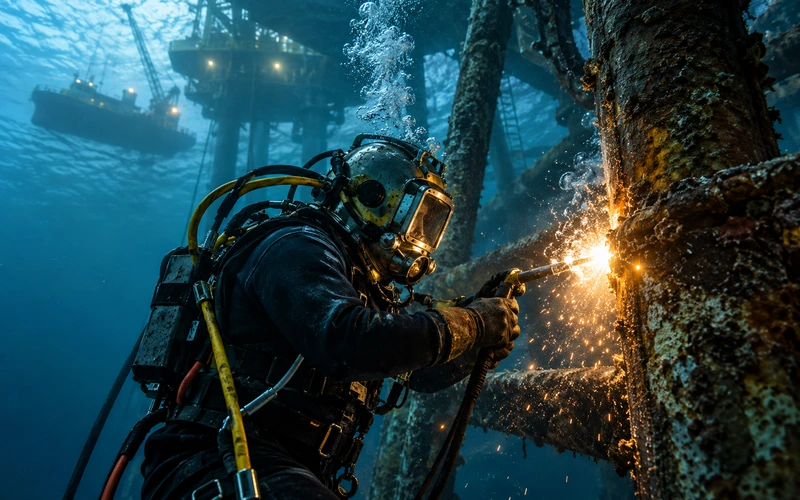
Underwater welders combine two hazardous jobs: commercial diving and welding. NIOSH notes that divers face drowning, respiratory and circulatory problems, and hypothermia, along with the same welding, heavy equipment, and power tool hazards found on construction sites. The most common dangers include:
• Drowning after equipment failure, entanglement in lines or nets, or loss of air supply.
• Differential pressure, where water rushing toward an opening in a pipe, valve, or intake can pin a diver with crushing force.
• Electric shock from wet welding and cutting equipment that is poorly insulated or improperly grounded.
• Decompression sickness and arterial gas embolism from ascending too fast or from errors in dive planning.
• Explosions when gas pockets trapped in a structure ignite during cutting or welding.
• Hypothermia, low visibility, strong currents, and vessel traffic overhead.
The CDC's review of diving deaths found recurring safety failures: no properly prepared standby diver, no reserve air, and divers working with only recreational training. OSHA's commercial diving standards require safeguards such as a standby diver and trained dive teams. When an employer or vessel owner skips those steps, the resulting injuries are often preventable, and that matters a great deal for a legal claim.
Which law covers you depends on where you were working, who employed you, and how connected your job was to a vessel. The three main paths are the Jones Act, the LHWCA, and general maritime law, and they are not interchangeable.
The Jones Act lets a seaman sue his employer for negligence, which can recover full damages for lost wages, medical costs, and pain and suffering. To qualify, a worker must contribute to the function or mission of a vessel and have a connection to an operating vessel (or fleet of vessels) that is substantial in both duration and nature. Under the U.S. Supreme Court's Chandris decision, spending less than about 30% of working time on a vessel generally falls short.
In Texas and the rest of the Fifth Circuit, the 2021 en banc decision in Sanchez v. Smart Fabricators of Texas added questions about whether the worker owes allegiance to the vessel or to a shoreside employer, whether the work is sea-based, and whether the assignment is a discrete job or ongoing service. Divers who live aboard dive support vessels for long stretches often have strong seaman claims. Divers sent to a single platform repair may not.
Divers who do not qualify as seamen are often covered by the LHWCA, a federal no-fault system for maritime workers injured on U.S. waters and adjoining areas such as piers and shipyards. Through the Outer Continental Shelf Lands Act, similar benefits reach many workers on offshore oil and gas platforms. The LHWCA pays medical treatment and a portion of lost wages, but it generally bars suing your own employer. Notice of the injury should be given to the employer within 30 days, and a claim must usually be filed within one year.
General maritime law fills important gaps. Seamen can claim maintenance and cure, meaning daily living expenses and medical care until they reach maximum recovery, regardless of fault. They can also bring unseaworthiness claims when a vessel or its equipment was not reasonably fit for the job. Divers covered by the LHWCA may still sue negligent third parties, such as a vessel owner, platform operator, or equipment manufacturer. Many maritime personal injury claims carry a three-year limitations period, but the deadline that applies to your case should be confirmed early.
Families who lose a diver may have wrongful death claims under the Jones Act, general maritime law, the LHWCA, or the Death on the High Seas Act when the death occurs far offshore. Each law limits who can file and what damages are available, so the right choice of law can change the value of a case significantly. Our article on major offshore drilling accidents shows how quickly offshore operations can turn deadly when safety systems fail.
Diving accidents also cause catastrophic injuries that survivors live with for decades, including brain damage from oxygen deprivation, spinal cord injuries from decompression illness, amputations, and severe burns. These claims require careful medical documentation and an accurate projection of future care costs.
Our founder, John Daspit, began his career at Fulbright & Jaworski and devoted 7,000 to 8,000 hours to litigation arising from the 2005 BP Texas City Refinery explosion. Today our team of more than 50 attorneys has recovered over $500 million for clients and handles industrial accident and maritime claims from offices across Texas, including Houston, Beaumont, Galveston, and Corpus Christi.
• Free consultations, available 24/7.
• No legal fees unless we win your case.
• Home and hospital visits for injured workers who cannot travel.
• Investigation of dive logs, equipment records, and safety practices to identify every responsible party.
Underwater welders take on extraordinary risks to keep offshore energy, shipping, and infrastructure running. If a preventable accident changed your life or took someone you love, you have rights, and the sooner you act, the more evidence can be preserved. Call The Daspit Law Firm at (888) 273-1045 for a free, confidential review of your case.
Federal data put the commercial diving fatality rate at roughly 150 to 180 deaths per 100,000 workers per year. The CDC calculated 180 per 100,000 for full-time commercial divers from 1989 to 1997, about 40 times the rate for all workers. Underwater welders fall within this group, and no agency tracks them separately.
About five to six commercial divers die on the job in the United States each year, based on federal data. BLS recorded 39 commercial diver deaths from 2011 to 2017, and earlier CDC figures showed about five deaths per year among full-time commercial divers. These counts include underwater welders along with other diving trades.
No. The 15% figure appears on many websites without a supporting study. A 15% annual rate would mean hundreds of deaths each year among roughly 3,000 commercial divers, while federal data show about five or six. The real risk is still very high, roughly dozens of times the average for all U.S. workers.
Yes, if the diver qualifies as a seaman. That generally requires contributing to a vessel's mission and having a substantial connection to an operating vessel, often measured by spending about 30% or more of work time aboard. Divers who do not qualify may still receive LHWCA benefits or sue negligent third parties.
Deadlines depend on the law that applies. Many maritime personal injury claims, including Jones Act claims, must be filed within three years. LHWCA claims require notice to the employer within 30 days and a claim filed generally within one year. Because the right law is not always obvious, it is wise to speak with a lawyer quickly.
All too often, accident victims are steamrolled by insurance companies determined to minimize or deny their claims. Don't let this happen to you. Hire us to fight for the compensation you deserve.


At The Daspit Law Firm, Our Team of Attorneys Handles the Full Range of Personal Injury Cases, Including Car and Truck Accidents, Industrial Accidents, Construction Accidents, Maritime & Offshore Accidents, and Much More.
The information on this website is for general information purposes only. Nothing on this site should be taken as legal advice for any individual case or situation. This information is not intended to create, and receipt or viewing does not constitute, an attorney-client relationship.
© 2026 All Rights Reserved. Privacy Policy, Accessibility, Legal Disclaimer