Texas does not issue a boating license the way it issues a driver's license, but many boaters do need a boater education certificate. If you were born on or after September 1, 1993, Texas requires you to complete an approved boater education course before operating a personal watercraft, a motorboat with more than 15 horsepower, or a windblown vessel over 14 feet long. These rules matter for safety, and they can also matter in a boat accident claim.
This guide explains who needs certification, the age rules for young operators, Texas boating while intoxicated (BWI) law, what to do after a crash on the water, and who can be held responsible when someone gets hurt.
This article is general information, not legal advice. Boating rules can change, so check Texas Parks and Wildlife Department (TPWD) guidance before you head out.
TPWD sets 13 as the minimum age to operate a personal watercraft or a motorboat with more than 15 horsepower on public water without supervision. A child under 13 can operate one of these vessels only when supervised by a qualifying adult who is on board.
Teens who are 13 or older and born after the 1993 cutoff still need to complete boater education to operate on their own. Parents who hand over the keys to a jet ski should make sure their child has completed the course and understands the rules.
TPWD explains that certain operating violations, such as reckless or negligent operation, excessive speed, creating a hazardous wake, and blocking passage, can require the operator to complete an approved boater education course in addition to paying a fine. Failing to complete the course within 90 days is a Parks and Wildlife Class A misdemeanor.
Texas treats drinking and boating much like drinking and driving. Under Penal Code Section 49.06, a person commits BWI by operating a watercraft while intoxicated. Intoxicated means having an alcohol concentration of 0.08 or more, or not having the normal use of mental or physical faculties because of alcohol or drugs. The Penal Code defines watercraft broadly to include vessels, water skis, and similar devices, but not devices moved only by the current. A first BWI is generally a Class B misdemeanor with a minimum of 72 hours in jail. The same intoxication standard applies on Texas roads, where impaired drivers cause many serious car accident injuries.
If an intoxicated boat operator seriously injures or kills someone, they can face intoxication assault or intoxication manslaughter charges, the same felonies that apply to drunk drivers. Under the Alcoholic Beverage Code, anyone under 21 also commits an offense by operating a watercraft with any detectable amount of alcohol.
Boating crashes are less common than car crashes, but they can be just as deadly. According to TPWD's 2025 boating incident report, Texas recorded 178 reportable recreational boating incidents in 2025, with 50 deaths and 77 people injured. Careless or reckless operation and operator inattention were the leading primary causes, followed by operator inexperience. Of the 35 people who drowned, 31 were not wearing a life jacket.
TPWD's data also shows that, among operators involved in 2025 incidents, about a third had no boating safety education on record, and the education status of many others was unknown.
Most boating deaths and injuries are preventable. Whether or not the law requires you to take a course, these habits can protect you and your passengers.
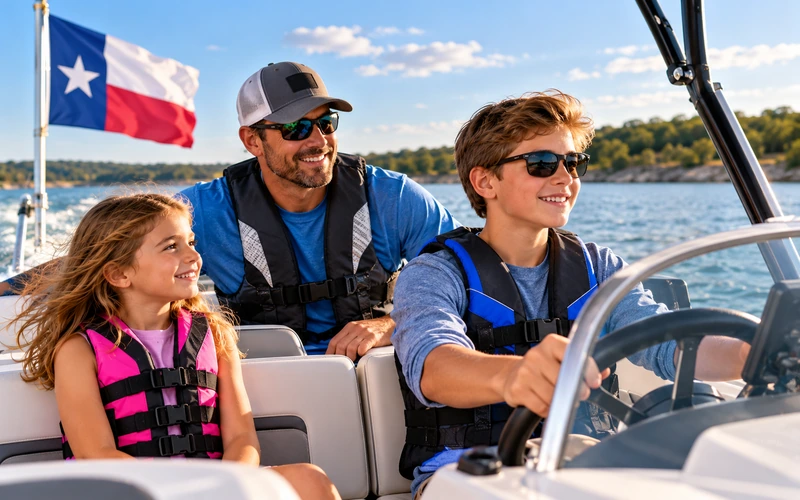
• Make sure everyone on board has a properly fitting life jacket, and have children and weak swimmers wear one at all times.
• Assign a sober operator and keep alcohol off the boat if you are the one driving.
• Keep a steady lookout and watch your speed in crowded coves, near swimmers, and around docks.
• Check the weather before leaving and head back early if storms build.
• Use an engine cut-off switch lanyard so the boat stops if the operator falls overboard.
Texas law sets specific duties for boat operators involved in a collision or accident. These steps protect both the people involved and any later injury claim.
1. Help anyone who is hurt or in the water, as long as you can do so safely. Operators have a legal duty to give reasonable assistance.
2. Call 911 or the TPWD 24-hour communications line at (512) 389-4848 to reach a game warden.
3. Exchange information. Operators must give their name, address, and vessel identification in writing to injured people and to owners of damaged property.
4. Report the accident. A report is required when someone dies, when someone needs medical treatment beyond first aid, or when damage exceeds $2,000. Deaths must be reported within 48 hours, and written reports go to TPWD within 30 days.
5. Document the scene with photos of the vessels, injuries, weather, and water conditions, and collect witness names.
6. Get medical care and keep all records of your treatment and expenses.
For full details, see TPWD's boating accident reporting page.
Liability depends on who acted carelessly and what caused the crash. Common sources of responsibility include the following.
• Boat operators who were careless, speeding, distracted, inexperienced, or intoxicated.
• Boat owners who let an untrained or impaired person operate their vessel.
• Rental companies that failed to give safety briefings, check certification, or maintain equipment.
• Manufacturers of defective boats, engines, or safety gear, under product liability law.
• Marinas or property owners that failed to keep docks and facilities reasonably safe.
An operator's lack of a required boater education certificate does not by itself prove they caused a crash, but it can be strong evidence of inexperience or careless operation. Boating cases can also involve federal maritime law when the accident happens on navigable waters, which can affect deadlines and damages. Commercial vessel and offshore crashes raise separate issues covered by maritime injury law. For claims governed by Texas law, most injury suits must be filed within two years under Civil Practice and Remedies Code Section 16.003.
The Daspit Law Firm has more than 50 attorneys and has recovered over $500 million for clients. We investigate how boat crashes happen, including operator training, alcohol use, equipment failures, and rental practices. We work on a contingency fee, so you pay no legal fees unless we win, and we can visit you at home or in the hospital. With offices across Texas, including Galveston, we serve families who live, work, and play on the water.
A day on the lake or the bay should never end in tragedy. If you or a loved one was hurt in a boating accident, call The Daspit Law Firm at (888) 273-1045 for a free consultation, available 24/7. We are ready to fight for you.
Texas does not issue a boating license, but it does require a boater education certificate for many operators. If you were born on or after September 1, 1993, you must complete an approved course before operating a personal watercraft, a motorboat over 15 horsepower, or a windblown vessel over 14 feet, unless a qualified adult supervises you on board.
You must be at least 13 to operate a personal watercraft or a motorboat with more than 15 horsepower on public water without supervision, and you must also complete boater education if born on or after September 1, 1993. A child under 13 can operate only when an adult who is at least 18 and legally able to operate the boat is on board.
The boater education requirement applies based on the operator's birth date and the type of vessel, so renting does not create an exception. If you were born on or after September 1, 1993, you generally need certification or qualifying adult supervision to operate a rented personal watercraft. TPWD also offers a one-time 15-day deferral for $10.
The legal limit is the same as for driving: an alcohol concentration of 0.08. You can also be charged with boating while intoxicated at a lower level if alcohol or drugs have taken away the normal use of your mental or physical faculties. Operators under 21 commit an offense with any detectable amount of alcohol while operating a watercraft.
Texas requires a report when a boating accident causes a death, an injury that needs medical treatment beyond first aid, or more than $2,000 in damage. Deaths must be reported within 48 hours. A written report must go to Texas Parks and Wildlife within 30 days, and operators must render aid and share their identification.
All too often, accident victims are steamrolled by insurance companies determined to minimize or deny their claims. Don't let this happen to you. Hire us to fight for the compensation you deserve.


At The Daspit Law Firm, Our Team of Attorneys Handles the Full Range of Personal Injury Cases, Including Car and Truck Accidents, Industrial Accidents, Construction Accidents, Maritime & Offshore Accidents, and Much More.
The information on this website is for general information purposes only. Nothing on this site should be taken as legal advice for any individual case or situation. This information is not intended to create, and receipt or viewing does not constitute, an attorney-client relationship.
© 2026 All Rights Reserved. Privacy Policy, Accessibility, Legal Disclaimer