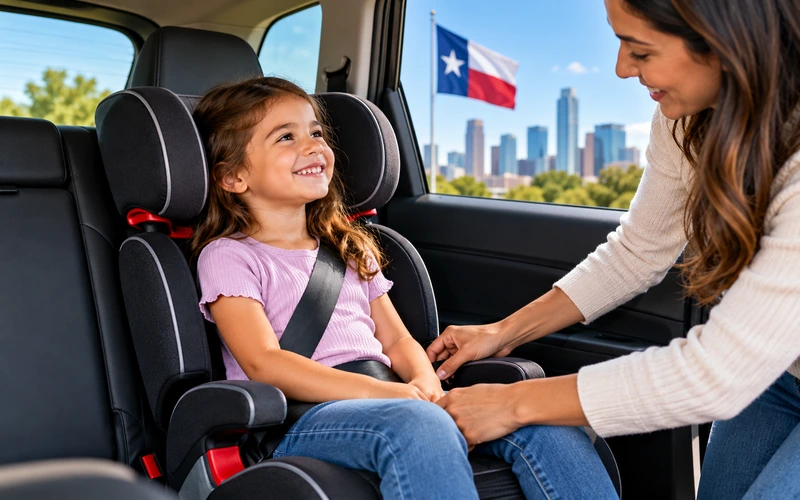
Texas booster seat requirements are simple to state: a child younger than 8 must ride in a car seat or booster seat unless the child is taller than 4 feet 9 inches. Texas law does not set a specific weight requirement for booster seats. Instead, it requires the seat to be used according to the manufacturer's instructions, which include weight and height limits. If your child was hurt in a crash, these rules can also come up in a car accident claim, so it helps to understand them.
Below, we cover what the Texas booster seat law says, the fines for breaking it, what safety experts recommend at each stage, and how car seat use can affect a child injury claim in Texas.
This article is general information, not legal advice. Car seat models differ, so always check your seat's label and manual.

Texas Transportation Code Section 545.412 makes it an offense to drive a passenger vehicle with a child younger than 8 who is not secured in a child passenger safety seat system, unless the child is taller than 4 feet 9 inches. The seat must be used as the seat maker instructs and must meet federal crash-test standards set by the National Highway Traffic Safety Administration. The Texas Department of Public Safety summary of restraint laws lays out these rules and the related fines.
No. The Texas statute uses age and height, not weight. However, because the law requires the seat to be used according to the manufacturer's instructions, the weight and height limits printed on your booster or car seat still matter. Many boosters list a minimum weight around 40 pounds, but limits vary by model, so read your seat's label.
Legally, a child can stop using a booster once they turn 8 or once they are taller than 4 feet 9 inches, whichever comes first. Safety experts recommend keeping a child in a booster until the adult seat belt fits correctly, which for many children is not until age 10 to 12.
Texas also has seat belt rules for older children and a few defenses that can apply. Here is how the rules fit together.
• Car seat or booster violation (Section 545.412): a misdemeanor with a fine of $25 to $250.
• Unbelted child under 17 who is not required to use a car seat (Section 545.413): the driver can be fined $100 to $200.
• Anyone 15 or older riding unbelted: a fine of $25 to $50.
• Defenses to the car seat offense include emergencies, law enforcement purposes, vehicles that carry passengers for hire, and situations where every seating position with a belt or seat is already occupied.
• Under Section 545.4121, a first-time ticket can be defeated if the driver had no seat in the car, was not cited for anything else, was not in a crash, and later shows the court they got a proper seat.
Texas also prohibits letting a child under 18 ride in the open bed of a pickup or flatbed truck, with limited exceptions such as parades and some farm uses.
Even the right seat cannot fully protect a child if it is installed or used incorrectly. TxDOT's child passenger safety program cites NHTSA's finding that 46 percent of car seats are misused, and it offers free car seat inspections at district offices around the state. NHTSA also reports that car seats saved the lives of 325 children under age 5 in a single year, and that 39 percent of children killed in 2024 crashes were unrestrained.
When a child is hurt in a crash caused by another driver, parents often worry that an imperfect car seat setup will ruin the claim. The rules here have changed over time, so it helps to know where things stand.
For years, Texas law barred evidence of seat belt use or nonuse in civil cases. The Legislature repealed that ban in 2003, removing former Section 545.413(g). In 2015, in Nabors Well Services v. Romero, the Texas Supreme Court held that relevant evidence of seat belt use or nonuse is admissible to help a jury apportion responsibility. A defendant generally needs evidence, often expert testimony, that the lack of restraint actually caused or worsened the injuries.
A young child cannot buckle themselves, so the focus usually shifts to the adults. An insurer or defense lawyer may argue that the driver who did not properly restrain the child shares responsibility for the child's injuries. Whether that argument succeeds depends on the facts, the medical evidence, and how Texas comparative fault rules apply. It does not change the fact that the driver who caused the crash can be held responsible for the harm.
Children's claims also have special timing rules. In Texas, the two-year limitations period for a minor's own injury claim is generally paused until the child turns 18, but parents' claims for the child's medical bills follow different deadlines. A lawyer can sort out which deadline applies to each part of the case.
The Daspit Law Firm has more than 50 attorneys and has recovered over $500 million for clients. When a child is seriously hurt, we work to document every injury, including those that could affect growth and development, and we pursue compensation for medical care, future treatment, and the family's losses. For the most serious cases involving catastrophic injuries or wrongful death, we bring the resources these claims demand.
We work on a contingency fee, so you pay no legal fees unless we win, and we can meet your family at home or in the hospital. If you need help getting the crash report, our guide on filing a police report explains the process. With our main office in Houston and offices across Texas, we are close by.
Your child's safety comes first, and so does your family's recovery. Call The Daspit Law Firm at (888) 273-1045 for a free consultation, available 24/7. We are ready to fight for you.
Texas law requires children younger than 8 to ride in a car seat or booster seat unless they are taller than 4 feet 9 inches. The seat must meet federal standards and be used according to the manufacturer's instructions. Safety experts recommend keeping a child in a booster until the adult seat belt fits correctly, often between ages 8 and 12.
Texas law does not set a weight requirement for booster seats. The statute is based on age and height: under 8 years old unless taller than 4 feet 9 inches. Because the seat must be used as the manufacturer instructs, follow the weight and height limits printed on your booster, which vary from model to model.
A violation of the Texas child safety seat law is a misdemeanor punishable by a fine of $25 to $250. Under Section 545.4121, a driver may be able to beat a first ticket by showing the court they later obtained a proper seat, as long as they had no seat at the time, received no other citation, and were not in a crash.
Texas law does not set a specific age for riding in the front seat. However, NHTSA recommends keeping children in the back seat at least through age 12, and the American Academy of Pediatrics says the back seat is the safest place for all children under 13. Never place a rear-facing seat in front of an active airbag.
It can be raised, but it does not end the claim. Since the Texas Supreme Court's 2015 Nabors decision, relevant evidence of restraint use may be admitted to apportion responsibility, usually with expert proof that it affected the injuries. The driver who caused the crash can still be held responsible, so talk with a lawyer before assuming your case is weak.
All too often, accident victims are steamrolled by insurance companies determined to minimize or deny their claims. Don't let this happen to you. Hire us to fight for the compensation you deserve.


At The Daspit Law Firm, Our Team of Attorneys Handles the Full Range of Personal Injury Cases, Including Car and Truck Accidents, Industrial Accidents, Construction Accidents, Maritime & Offshore Accidents, and Much More.
The information on this website is for general information purposes only. Nothing on this site should be taken as legal advice for any individual case or situation. This information is not intended to create, and receipt or viewing does not constitute, an attorney-client relationship.
© 2026 All Rights Reserved. Privacy Policy, Accessibility, Legal Disclaimer