The shoulder of the road is the strip of pavement or gravel next to the travel lanes, usually outside the solid white edge line, set aside for emergencies and stopping rather than normal driving. In Texas, you may drive on a paved shoulder only for seven specific purposes, and only when it is necessary and safe. If someone breaks those rules and hits you, a car accident lawyer can help you hold them accountable.
Shoulders save lives by giving drivers room to pull over, avoid collisions, and wait for help. They are also the scene of some of the most dangerous crashes on Texas highways, when a distracted or impaired driver drifts out of the lane and strikes a stopped car, a tow operator, or a person changing a tire.
Below, we explain how Texas law defines the shoulder, when driving on it is legal, what the Move Over or Slow Down law requires, and who is responsible when a crash happens on the side of the road.
Texas Transportation Code Section 541.302 defines a shoulder as the part of a highway next to the roadway that is designed or ordinarily used for parking, is separated from the roadway by design, construction, or markings, and is not intended for normal vehicle travel. An improved shoulder is simply a paved shoulder. The roadway itself is the part of the highway, other than the shoulder or berm, that is built for driving.
In everyday terms, the right shoulder is the space to the right of the solid white edge line, often called the fog line. On divided highways and freeways, there may also be a narrower left shoulder next to the median, separated from the fast lane by a solid yellow line.
Under Texas Transportation Code 545.058, driving on an improved shoulder is permitted only in limited situations. Two conditions apply every time: the move must be necessary, and it must be done safely.
You may drive on the improved shoulder to the right of the main traveled lanes only to:
1. Stop, stand, or park.
2. Accelerate before entering the main traveled lane of traffic.
3. Slow down before making a right turn.
4. Pass another vehicle that is slowing or stopped on the main roadway, disabled, or preparing to turn left.
5. Allow a faster vehicle to pass.
6. Follow an official traffic-control device that permits or requires shoulder use.
7. Avoid a collision.
The courtesy move many Texans know well, easing onto the shoulder on a two-lane highway so a faster car can pass, is legal under purpose five, but only if the shoulder is clear and you can do it safely. Using the shoulder to skip a traffic jam or to speed past an exit line is not on the list.
On divided, limited-access, or controlled-access highways, you may drive on the left improved shoulder only to slow or stop a disabled vehicle when traffic or other conditions keep you from reaching the right shoulder, when a traffic-control device allows it, or to avoid a collision.
These limits do not apply to emergency vehicles responding to a call, police patrols, bicycles, or slow-moving vehicles as defined by state law. Cyclists in particular often ride on the shoulder, which is one reason drivers who drift onto it can cause bicycle accidents with devastating results.
Shoulders are where first responders and road crews work. Texas Transportation Code 545.157 requires drivers approaching certain stopped vehicles with their warning lights on to either move out of the lane closest to the vehicle, if there are two or more lanes going the same direction, or slow to 20 mph below the posted speed limit. If the limit is under 25 mph, drivers must slow to 5 mph.
The law covers police, fire, and EMS vehicles, tow trucks, TxDOT and highway maintenance vehicles, utility service vehicles, solid waste and recycling trucks, and toll project vehicles. Effective September 1, 2025, Senate Bill 305 expanded the protection to more public service vehicles, including animal control vehicles, after two animal control officers were killed in a 2022 crash in Levelland.
Penalties are significant. A first offense carries a fine of $500 to $1,250. A violation that causes bodily injury is a Class A misdemeanor, and a repeat injury offense can be charged as a state jail felony. A Move Over violation is also strong evidence of negligence in a civil injury claim.
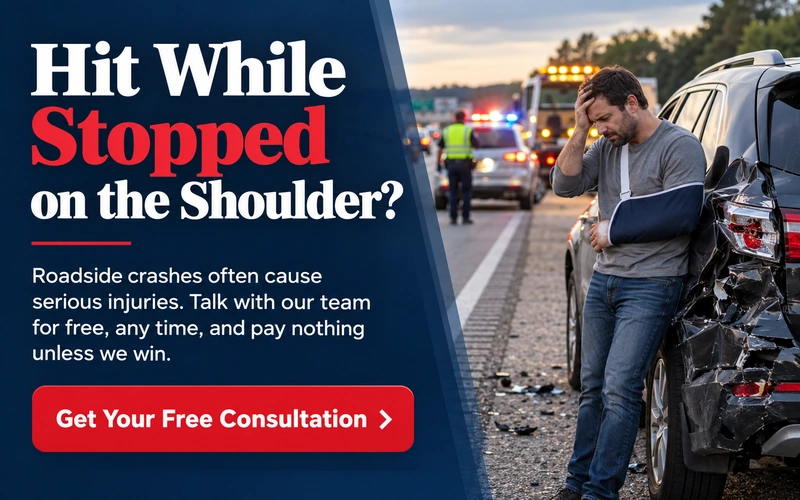
People on the shoulder are often outside their vehicles or sitting still with no way to escape. The AAA Foundation for Traffic Safety, citing NHTSA data, reports that more than 2,100 people were killed outside disabled vehicles at the roadside from 2019 to 2023, including tow operators, police officers, EMS crews, stranded motorists, and Good Samaritans. The Foundation notes that number is likely an undercount.
Common causes of shoulder crashes include:
• Distracted driving, especially phone use, that lets a vehicle drift across the fog line.
• Drunk or drowsy driving, particularly at night.
• Drivers illegally using the shoulder to pass traffic.
• Failure to move over or slow down for stopped vehicles.
• Large trucks drifting or cutting corners, a frequent factor in truck accidents on Texas interstates.
• Poorly maintained shoulders with drop-offs, debris, or missing pavement.
Liability depends on who violated a duty of care. Texas negligence law, including the concept of negligence per se for traffic violations, usually decides these cases.
A driver who leaves the travel lane and strikes a vehicle or person lawfully stopped on the shoulder is usually at fault. Driving on the shoulder for a purpose not allowed by Section 545.058, or failing to move over under Section 545.157, can support a negligence per se claim. If the driver was working at the time, such as a delivery or commercial truck driver, the employer may also be responsible.
Drivers who stop on the shoulder also have responsibilities. Texas law generally requires a stopped vehicle to leave enough room for traffic to pass and to be visible, and commercial vehicles must use warning devices when stopped. An insurer may argue a stranded motorist was partly at fault for stopping in a travel lane, having no lights on at night, or standing in traffic. Under Texas proportionate responsibility rules, you can still recover as long as you are not more than 50% at fault, but your recovery is reduced by your share.
Sometimes a crumbling edge, a steep pavement drop-off, or a missing shoulder contributes to a crash. Claims against a government entity are possible in limited circumstances under the Texas Tort Claims Act, but they require written notice within six months in most cases, and sometimes sooner under city rules.
1. Move to a safe spot away from traffic if you can, and call 911.
2. Get medical care, even if you feel fine. Adrenaline can hide serious injuries.
3. Photograph the scene, vehicle positions, skid marks, lighting, and the shoulder surface.
4. Collect witness names and request the crash report. Our guide on filing a police report explains the process.
5. Talk to a lawyer before giving a recorded statement to the other driver's insurer.
Most Texas injury claims must be filed within two years of the crash under Civil Practice and Remedies Code 16.003.
The Daspit Law Firm has more than 50 attorneys, has recovered over $500 million for clients, and serves injured Texans from offices in Houston, Austin, Dallas, Fort Worth, San Antonio, Beaumont, Galveston, and more. Our founder, John Daspit, also worked in insurance defense, so we understand the tactics insurers use to shift blame onto stranded drivers.
• Free consultations, 24 hours a day, 7 days a week.
• No legal fees unless we win.
• Home and hospital visits if you are recovering from your injuries.
If you were hurt on or near the shoulder of the road because another driver broke the rules, we are ready to fight for you. Call The Daspit Law Firm at (888) 273-1045 for a free case review. This article is general information and not legal advice.
The shoulder is the part of a highway next to the travel lanes, usually outside the solid white edge line, that is meant for stopping and emergencies rather than normal driving. Texas law defines it as an area separated from the roadway by design or markings and not intended for regular travel. A paved shoulder is called an improved shoulder.
It is illegal unless one of seven exceptions applies and the move is necessary and safe. Under Transportation Code 545.058, you may use the right shoulder to stop, accelerate onto the highway, slow for a right turn, pass a stopped or turning vehicle, let a faster car pass, follow a traffic sign, or avoid a collision.
Yes. Texas law allows drivers to use the improved right shoulder to let a faster vehicle pass, as long as doing so is necessary and can be done safely. Check that the shoulder is clear of people, debris, and stopped vehicles, signal, and return to the lane once the other car has passed.
When approaching covered stopped vehicles with warning lights, such as police, EMS, tow trucks, and TxDOT vehicles, you must move out of the nearest lane if possible or slow to 20 mph below the speed limit. A 2025 law added more public service vehicles, including animal control. First offenses carry fines of $500 to $1,250.
Usually the driver who left the travel lane and hit the stopped vehicle is at fault, especially if they were distracted, impaired, or failed to move over. The stopped driver can share some fault if, for example, they had no lights on at night. In Texas, you can recover damages if you are 50% or less at fault.
All too often, accident victims are steamrolled by insurance companies determined to minimize or deny their claims. Don't let this happen to you. Hire us to fight for the compensation you deserve.


At The Daspit Law Firm, Our Team of Attorneys Handles the Full Range of Personal Injury Cases, Including Car and Truck Accidents, Industrial Accidents, Construction Accidents, Maritime & Offshore Accidents, and Much More.
The information on this website is for general information purposes only. Nothing on this site should be taken as legal advice for any individual case or situation. This information is not intended to create, and receipt or viewing does not constitute, an attorney-client relationship.
© 2026 All Rights Reserved. Privacy Policy, Accessibility, Legal Disclaimer