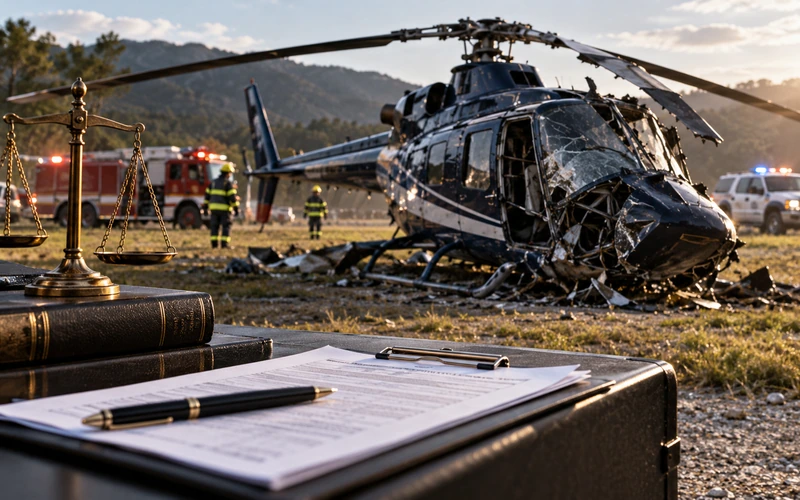
In recent years, the United States has seen roughly 90 to 130 civil helicopter accidents a year, with about a dozen to two dozen of them fatal. In 2024, the industry recorded 88 accidents and 13 fatal accidents, its safest year in a quarter century by several measures. When a crash does happen, an experienced aviation accident lawyer can determine whether the operator, the manufacturer, or a maintenance provider is responsible.
Helicopters fly missions few other aircraft can: medical transport, offshore oil and gas crew changes, law enforcement, news, tours, and crop spraying. Many of those missions involve low altitude, tight landing zones, and changing weather. Below, we break down the most recent crash data, how helicopter safety compares with airplanes, the most common causes, and how victims and families pursue compensation in Texas.

The most reliable counts come from National Transportation Safety Board (NTSB) accident records, which the U.S. Helicopter Safety Team (USHST), a joint government and industry group, uses to track trends.
According to data presented at the USHST meeting in March 2025 and reported by Vertical Aviation International, U.S. helicopters had 88 accidents in 2024, down 13% from 101 in 2023. Thirteen of those accidents were fatal, down from 17 the year before, and 30 people died. The overall accident rate fell to 2.99 per 100,000 flight hours, the lowest in 25 years.
Over a longer window, an analysis of NTSB records from 2015 through 2024 found annual accident counts ranging from 93 to 131, with roughly 365 deaths over the decade, or about 37 per year. That same analysis found Texas recorded more helicopter accidents than any other state during the period.
The USHST tracks five-year average fatal accident rates by the federal rule a flight operates under. Its July 2026 report showed the following rates for 2021 to 2025, per 100,000 flight hours:
• Part 91 (private, corporate, and many other noncommercial flights): 0.47
• Part 133 (external load work, such as lifting equipment by cable): 0.78
• Part 135 (commercial charter, air tours, and air ambulance): 0.43
• Part 137 (agricultural spraying): 1.12
The commercial Part 135 rate is above the team's goal of 0.17 for 2025 to 2029, which matters because those are flights where paying passengers and patients have the least control over safety decisions.
Helicopters are not safer than commercial airliners, which have far lower accident rates than any type of small aircraft. Compared with small private airplanes, however, recent helicopter safety numbers are in a similar range. AOPA's McSpadden Report put the overall U.S. general aviation fatal accident rate at 0.65 per 100,000 flight hours in 2023, while the helicopter fatal accident rate in 2024 was 0.44.
Those figures measure different years and include different mixes of flying, so they are not a perfect apples-to-apples comparison. The practical takeaway is that the risk depends heavily on the type of operation, the operator's safety culture, the weather, and the pilot's training. A scheduled airline flight remains the safest way to fly. A helicopter tour, medical flight, or offshore transfer carries more risk, and passengers must trust the operator to manage it.
The USHST reports that three categories, loss of control in flight, low-altitude strikes on objects such as wires and towers, and unintended flight into clouds or low visibility, accounted for 47% of fatal U.S. helicopter accidents from 2019 to 2024. Other recurring factors include:
• Pilot error, fatigue, or inadequate training for the mission or weather.
• Mechanical failure of the engine, transmission, tail rotor, or flight controls.
• Improper or skipped maintenance, including missed inspections and incorrect parts.
• Design or manufacturing defects in components or crash-resistant fuel systems.
• Operator pressure to fly in poor weather or to meet tight schedules.
• Air traffic control errors and midair collisions, such as the January 2025 collision near Ronald Reagan Washington National Airport between an Army Black Hawk and a regional airliner that killed 67 people.
Texas faces some of these risks more than most states. Helicopters shuttle crews to offshore platforms in the Gulf of Mexico, fly patients between hospitals across long rural distances, and work over refineries and pipelines along the coast. Workers injured on offshore crew flights may have claims that overlap with offshore injury law, which can change which deadlines and damages apply.
Most helicopter crashes involve more than one possible defendant. A thorough investigation looks at every link in the chain, from the pilot's decisions to the parts installed years earlier.
Tour companies, air ambulance services, and charter operators owe passengers a high degree of care. They can be liable for pilot negligence, poor training, unsafe dispatch decisions, and violations of federal aviation regulations. Employers are generally responsible for the negligence of pilots acting within the scope of their jobs.
When a defective engine, rotor system, control linkage, or fuel system causes or worsens a crash, the manufacturer may face product liability claims. The federal General Aviation Revitalization Act (GARA) generally bars suits against manufacturers of general aviation aircraft and parts more than 18 years after delivery. The clock restarts for replacement parts, and exceptions exist, including for passengers on medical emergency flights, people on the ground, and manufacturers that concealed safety information from the FAA.
Repair stations and mechanics can be liable for faulty work or missed defects. Depending on the facts, claims may also involve the aircraft owner, a parts distributor, or, in rare cases, the federal government for air traffic control errors under the Federal Tort Claims Act, which has strict notice rules. For international trips purchased on a single ticket, the Montreal Convention may govern claims against the air carrier, but it seldom applies to domestic helicopter flights.
The NTSB investigates every U.S. civil aviation accident. A preliminary report often comes out within weeks, but the final report and probable cause finding can take a year or longer. By federal law, the NTSB's board reports cannot be used as evidence in a civil damages lawsuit, and courts generally exclude its probable cause conclusions, though some factual material may be usable.
That means victims cannot rely on the NTSB to prove their case. Your legal team needs its own investigators and experts, often working while the wreckage and records are still available. Insurers for operators and manufacturers begin building their defense immediately, and you deserve the same head start.
Most Texas personal injury claims must be filed within two years under Civil Practice and Remedies Code 16.003, and wrongful death claims generally must be filed within two years of the death. Federal claims, such as those against the government, carry their own deadlines. Survivors may recover medical costs, lost income, pain and suffering, and, for families, loss of companionship and support. Crashes often cause catastrophic injuries such as burns, spinal cord damage, and traumatic brain injury that require lifetime care.
Our founder, John Daspit, began his career at Fulbright & Jaworski and devoted 7,000 to 8,000 hours to the complex litigation that followed the 2005 BP Texas City Refinery explosion. That experience with large, multi-party disasters carries over to aviation cases. With more than 50 attorneys, over $500 million recovered for clients, and offices across Texas and six other states, our team can take on operators, manufacturers, and their insurers.
• Free consultations, available 24/7.
• No legal fees unless we win.
• Home and hospital visits for injured clients and grieving families.
Helicopter crashes are rare, but when they happen the results are often devastating. If you were hurt or lost someone you love, call The Daspit Law Firm at (888) 273-1045 for a free, confidential consultation about your rights.
The U.S. typically records about 90 to 130 civil helicopter accidents a year. In 2024 there were 88 accidents, 13 of them fatal, with 30 deaths, according to data presented by the U.S. Helicopter Safety Team. An analysis of NTSB records found about 37 helicopter deaths per year on average from 2015 through 2024.
Helicopters are not safer than commercial airliners, which have far lower accident rates. Compared with small private planes, recent helicopter fatal accident rates are in a similar range. The U.S. helicopter fatal accident rate was 0.44 per 100,000 flight hours in 2024, while AOPA reported 0.65 for general aviation overall in 2023.
Loss of control in flight is one of the leading causes. The USHST reports that loss of control, low-altitude strikes on wires or other objects, and unintended flight into poor visibility together caused 47% of fatal U.S. helicopter accidents from 2019 to 2024. Mechanical failures, maintenance errors, and pilot decisions also play major roles.
Liability may fall on the operator and pilot, the helicopter or parts manufacturer, a maintenance provider, the aircraft owner, or in some cases the federal government for air traffic control errors. Many crashes involve several responsible parties. A full independent investigation is usually needed because NTSB board reports cannot be used as evidence in civil lawsuits.
Most Texas injury and wrongful death claims must be filed within two years. Claims against the federal government require an administrative claim within two years, and the General Aviation Revitalization Act can bar some claims against manufacturers after 18 years. Because several deadlines may apply at once, contact a lawyer as early as possible.
All too often, accident victims are steamrolled by insurance companies determined to minimize or deny their claims. Don't let this happen to you. Hire us to fight for the compensation you deserve.


At The Daspit Law Firm, Our Team of Attorneys Handles the Full Range of Personal Injury Cases, Including Car and Truck Accidents, Industrial Accidents, Construction Accidents, Maritime & Offshore Accidents, and Much More.
The information on this website is for general information purposes only. Nothing on this site should be taken as legal advice for any individual case or situation. This information is not intended to create, and receipt or viewing does not constitute, an attorney-client relationship.
© 2026 All Rights Reserved. Privacy Policy, Accessibility, Legal Disclaimer