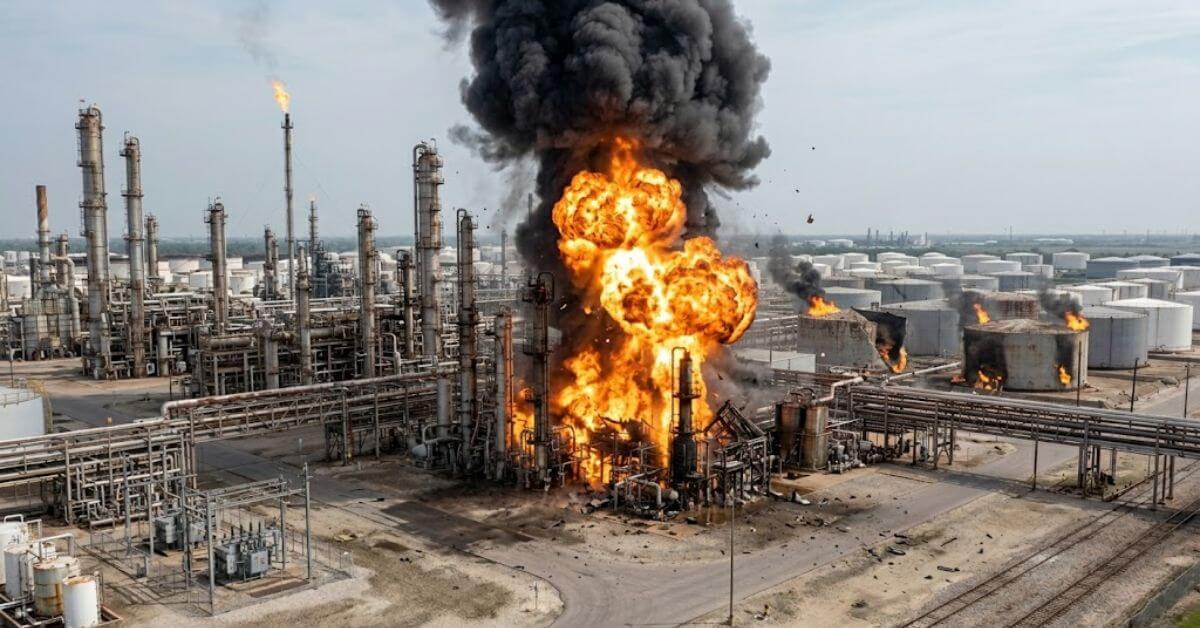
On Wednesday, March 22, 2023, a tanker truck explosion at the INEOS Phenol plant in Pasadena, Texas, sent a fireball and heavy smoke over State Highway 225. One person, a truck driver, was injured, and nearby roads were closed while crews fought the fire. When hazardous materials, trucking, and chemical plant operations come together, an injury claim can involve several companies at once, which is why many victims turn to an experienced plant accident attorney for guidance.
The fire was extinguished within a couple of hours, but the event raised familiar questions for people who live and work along the Houston Ship Channel. What causes these explosions? Who is responsible when a driver or worker is hurt during a chemical transfer? And what should neighbors do when they see a blast like this near their homes?
Below, we summarize the verified facts of the INEOS fire and explain the legal options available to injured workers, truck drivers, and residents under Texas law. This information is educational and is not a substitute for advice about your specific case.
According to ABC13 Houston, the incident happened at the INEOS Phenol facility along Highway 225 near the East Beltway. The Harris County Fire Marshal's Office said liquefied petroleum gas was being transferred through a hose from one over-the-road tanker to another when the first tanker developed an unintentional leak. The gas ignited, leading to what officials described as a BLEVE, or boiling liquid expanding vapor explosion.
INEOS Phenol said the LPG was a mixture of propylene and propane, a raw material used in its production process. The company said it was not yet clear exactly why the gas ignited during offloading, and the plant was shut down while investigators worked to determine the root cause.
One person was hurt: the driver of a third party bulk truck. Harris County Sheriff Ed Gonzalez said he was conscious, alert, and stable at the hospital. Early reports indicated possible burn injuries. All INEOS employees were accounted for, and no other injuries were reported.
As a precaution, authorities closed nearby roads, including the Harris County toll road and Highway 225. KHOU 11 reported that the fire was declared out just before 1:30 p.m. and that the closed roads reopened around the same time. Harris County Pollution Control Services monitored air north of Channelview and south of Highway 225 and reported no community impact. Maritime Executive reported that the Houston Ship Channel was briefly closed to vessel traffic.
A BLEVE happens when a container holding a pressurized liquid, such as propane or propylene, is heated or damaged until it ruptures. The liquid flashes into vapor almost instantly, and if that vapor ignites, it produces a powerful fireball and blast wave. Pieces of the container can be thrown long distances.
BLEVEs are among the most feared events in the petrochemical industry because they can happen with little warning and cause severe burns, blast injuries, and hearing damage to anyone nearby. Loading and unloading operations are a common point of failure, since hoses, couplings, valves, and pressure relief devices must all work correctly every time.
While the official cause of the INEOS fire was under investigation, industry experience shows that transfer incidents often involve one or more of the following:
• Worn, damaged, or incompatible transfer hoses and couplings
• Failure to bond and ground tanks and vehicles before transfer
• Leaking valves or faulty pressure relief devices on tanker trailers
• Ignition sources, such as running engines or electrical equipment, near the transfer area
• Incomplete training for drivers and plant operators on transfer procedures
• Poor communication between the plant, the trucking company, and the product supplier
Because so many parties touch a single transfer, these cases often overlap with truck accident claims, equipment defect claims, and plant safety claims all at once.
Determining fault after a tanker explosion means looking at everyone who had a role in the transfer. Depending on the evidence, responsible parties may include:
A plant controls its loading area, sets transfer procedures, and decides what safety equipment is required. When a third party driver is hurt on site, the owner may be liable if it failed to keep the premises reasonably safe or controlled the work in a careless way. In Texas, special rules under Chapter 95 of the Civil Practice and Remedies Code can apply when the injured person is a contractor's employee, so these claims need careful analysis.
The company that owned or maintained the tanker may be responsible for defective hoses, valves, or trailers. A manufacturer may face a product liability claim if a part was poorly designed or built. A driver's own employer may also be responsible for training failures.
If the injured person's employer carries Texas workers' compensation, benefits are usually available regardless of fault, but suing that employer is generally barred. If the employer is a non-subscriber, a negligence lawsuit may be possible. Claims against other companies, such as the plant owner or equipment maker, are separate and can include damages workers' compensation does not pay.
Burns from a fireball can require skin grafts, repeated surgeries, and months of rehabilitation. Some survivors face permanent scarring, limited mobility, nerve damage, and emotional trauma. These are often catastrophic injuries that change a person's ability to work and enjoy life. A fair recovery should account for future medical care, lost earning capacity, and pain and suffering, not just the bills already received.
• Most personal injury lawsuits must be filed within two years of the injury under Texas Civil Practice and Remedies Code Section 16.003.
• Texas uses modified comparative fault under Chapter 33. Your damages are reduced by your share of fault, and you cannot recover if you are found more than 50 percent responsible.
• Exemplary damages may be available for gross negligence under Chapter 41, subject to statutory caps.
• If an incident is fatal, certain family members may bring a wrongful death claim under Chapter 71.
Residents of Pasadena and nearby communities who experienced smoke exposure or property damage should also keep careful records. Our article on the Shell Deer Park fire explains additional steps neighbors can take after an industrial fire.
1. Get emergency medical care, and follow up with a burn specialist if your doctor recommends it.
2. Report the incident to your employer in writing and keep a copy for your records.
3. Write down the names of witnesses, the companies involved, and the truck and trailer numbers if you know them.
4. Keep every medical bill, pay stub, and receipt for travel or out of pocket costs.
5. Do not sign releases or give recorded statements to an insurance adjuster before speaking with a lawyer.
6. Contact an attorney quickly so evidence such as hoses, valves, and video can be preserved.
Founder John Daspit spent 7,000 to 8,000 hours on litigation stemming from the 2005 BP Texas City Refinery explosion. Before founding the firm, he worked at Fulbright & Jaworski and in insurance defense, which gives our team insight into how corporations and insurers defend industrial cases.
Our firm includes more than 50 attorneys, has recovered over $500 million for clients, and operates more than 15 offices, with our main office in Houston. We offer free consultations 24/7, make home and hospital visits, and work on contingency, so there are no legal fees unless we win.
If you or a loved one was injured in a tanker explosion, plant fire, or chemical release in Pasadena or anywhere in Texas, we are ready to fight for you. Call The Daspit Law Firm at (888) 273-1045 for a free, confidential consultation.
The Harris County Fire Marshal's Office said liquefied petroleum gas was being moved by hose from one tanker truck to another when the first tanker developed an unintentional leak. The gas ignited and caused a BLEVE on March 22, 2023. INEOS Phenol said the exact reason for ignition was still under investigation.
Yes, one person was injured. The driver of a third party bulk truck was taken to the hospital and was reported conscious, alert, and stable, with possible burn injuries. All INEOS employees were accounted for, and officials did not report any other injuries. Harris County reported no impact to community air quality.
A BLEVE, or boiling liquid expanding vapor explosion, happens when a tank holding a pressurized liquid such as propane ruptures. The liquid turns to vapor almost instantly, and if it ignites, it creates a large fireball and blast wave. BLEVEs can cause severe burns and throw tank fragments long distances.
Often, yes. A driver employed by a trucking company is usually a third party to the plant, so the driver may bring a negligence claim against the plant owner, another contractor, or an equipment manufacturer. Texas Chapter 95 rules may limit claims against property owners in some contractor situations, so a lawyer should review the facts.
In most cases, you have two years from the date of injury to file a personal injury lawsuit under Texas Civil Practice and Remedies Code Section 16.003. Wrongful death claims generally must be filed within two years of the death. Starting early helps your attorney preserve evidence such as hoses, valves, and video.
All too often, accident victims are steamrolled by insurance companies determined to minimize or deny their claims. Don't let this happen to you. Hire us to fight for the compensation you deserve.


At The Daspit Law Firm, Our Team of Attorneys Handles the Full Range of Personal Injury Cases, Including Car and Truck Accidents, Industrial Accidents, Construction Accidents, Maritime & Offshore Accidents, and Much More.
The information on this website is for general information purposes only. Nothing on this site should be taken as legal advice for any individual case or situation. This information is not intended to create, and receipt or viewing does not constitute, an attorney-client relationship.
© 2026 All Rights Reserved. Privacy Policy, Accessibility, Legal Disclaimer